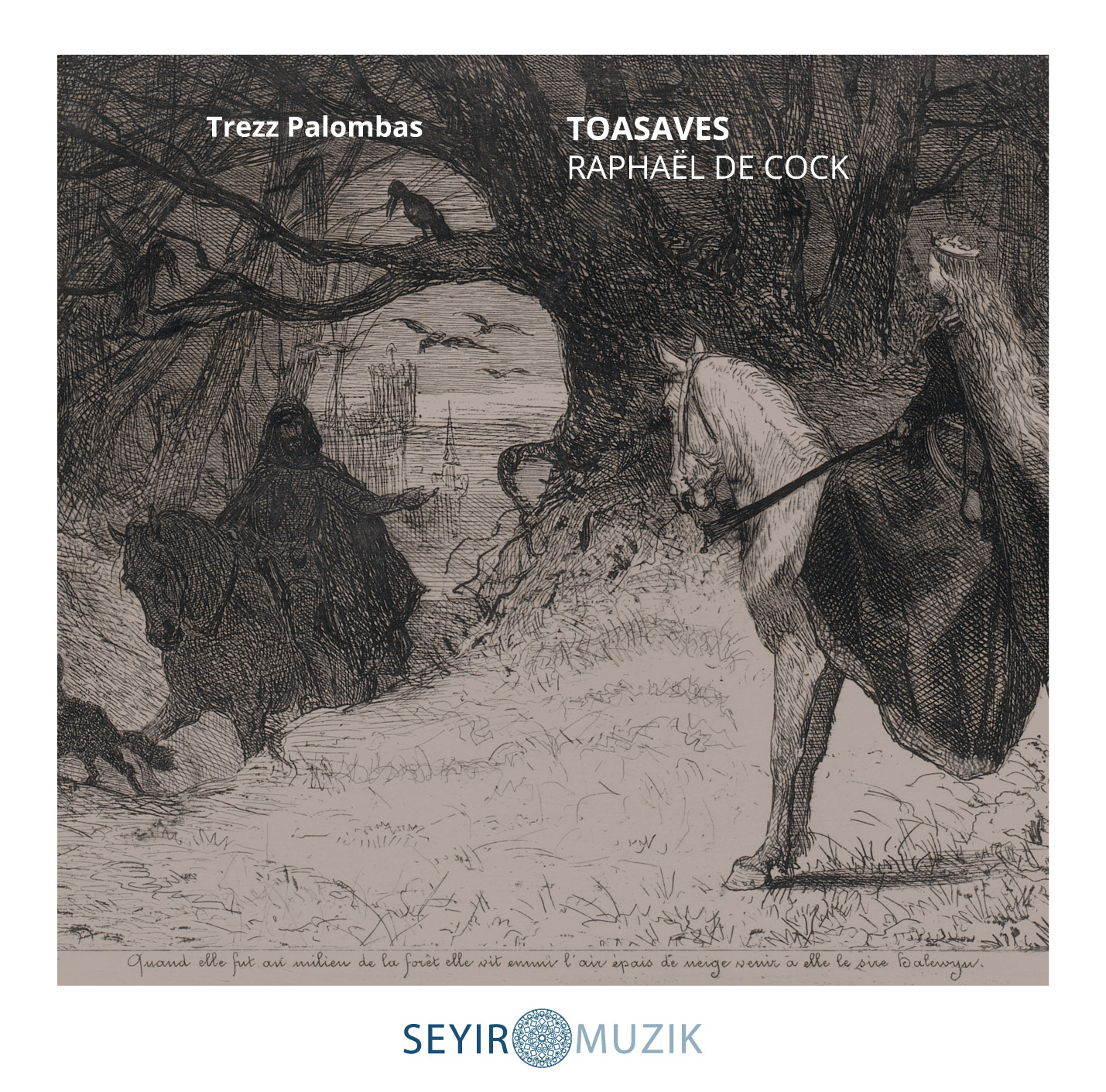
TOASAVES, RAPHAËL DE COCK
Trezz Palombas
Release date: 22.05.2026
Catalogue number: 2GN040
Format: EP / DIGITAL
FEATURED ARTISTS: Dick van der Harst: percussion. Michaël Grébil Liberg: vocals, medieval lute, lavta, Corsican cittern, cetera oscura, vielle, Afghan rebab, Eugénie De Mey: vocals, Pierre Hamon: medieval flutes, bagpipes, Tristan Driessens: oud, lavta, artistic direction, Michalis Kouloumis: violin, viola, Miriam Encinas Lafitte: vielle, dilruba, medieval flutes, frame drums, Raphaël De Cock: vocals, bagpipes, Jew’s harp, arrangments, Harald Bauweraerts: hurdy-gurdy.
TRACKLIST
01 Trezz Palombas Part I (8:22)
02 Trezz Palombas Part II (5:31)
03 Trezz Palombas Part III (4:25)
04 Trezz Palombas Part IV (5:04)
05 Trezz Palombas Part V (4:47)
Total time: 28:10
CREDITS
Recorded April 2021
Begijnhofkerk, Sint-Truiden, Belgium
Ingeneer: Lambert Colson
Mastering: Vincent De Bast
Design: Eleni Lomvardou
Produced by Seyir Muzik
Description
Trezz Palombas brings a compilation of several versions of the same ballad found all over Europe and beyond combining versions of the “Cancionero del Franco Rico” or “Romance de Isabel” (Spain, Portugal) with “El Maurico Franco – Tres palombas van volando” (Sephardic) and finally the “Ballade van Serolewijn” or “Heer Halewijn” (Flanders and The Netherlands)
We start our “ballade” from the East with historically probably the older known versions (sephardic =< 1499 AD) , over Spanish and Portuguese versions including from the Azores and Madeira which are still sung even today, to orally transmitted versions collected since 1836 in Flanders and Dutch speaking areas. The Flemish versions appear to have maintained most elements of the entire story with some intriguing ancient Celtic and Germanic elements. Interestingly a group of Flemish settlers where the first to establish a foothold on the Azorean island Ilha de Faial in 1468 AD, and hence the name of Flamengos Valley, but there was also a Flemish settlement in Ilha de São Jorge since 1480. The fertile soils and temperate climate also attracted Flemish people to Ilha de São Miguel. Did these Flemish settlers introduce the ballad in the area, or did the Portuguese or the Sephardi? Because last but not least and to close this “balladic” cycle, several important Portuguese-Jewish families settled in the Azores in the 15th century, shortly after the islands were discovered. Portuguese Jews fled from mainland Portugal to the Azores to escape the Portuguese Inquisition and even some Moors were exiled to the islands. Raphaël De Cock